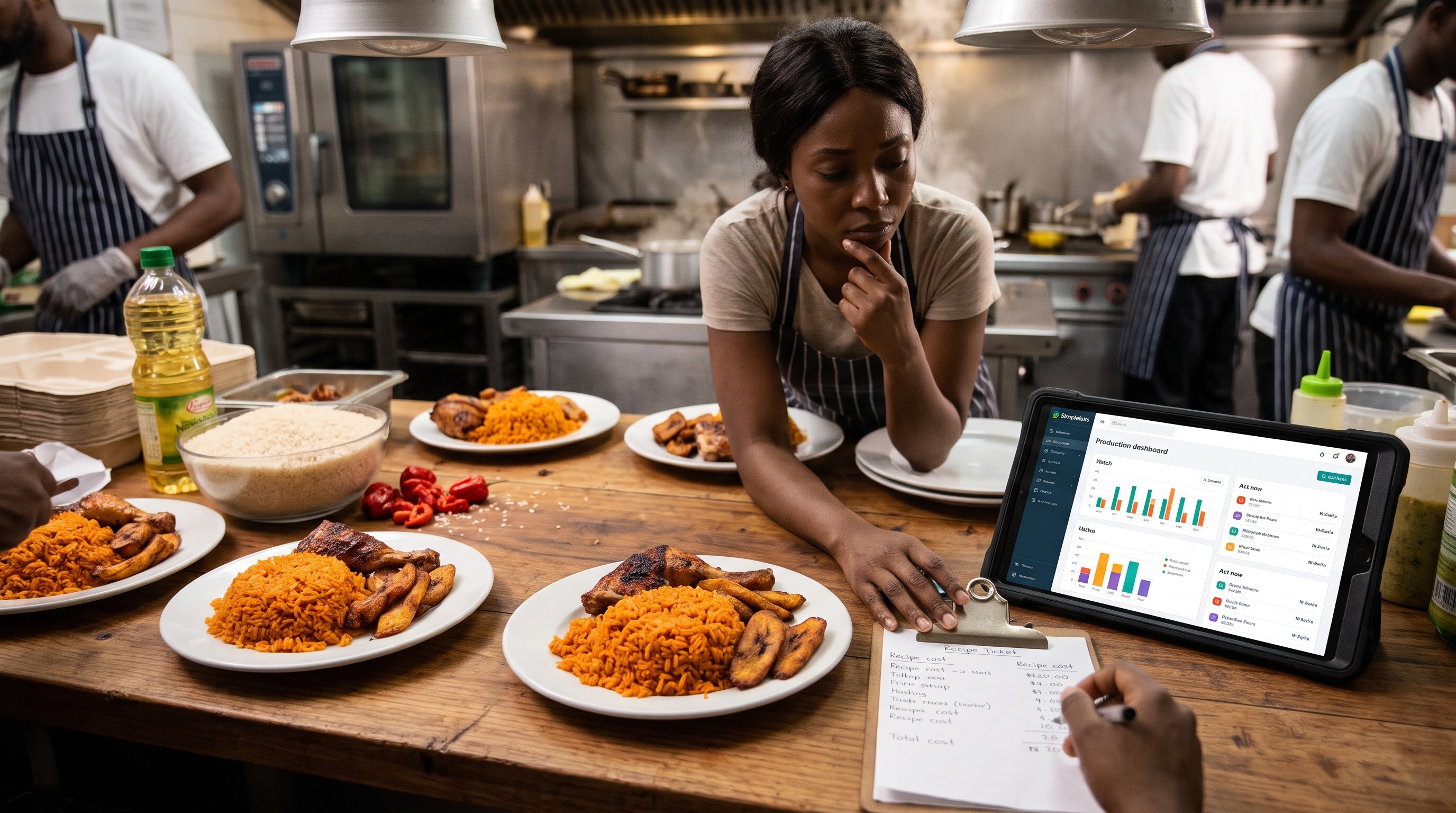
Restaurants and food producers often sell their most popular items at a loss without knowing it. A production dashboard can show you which ones.
Every restaurant has a dish that sells all week. It's the one customers ask for by name, the one the kitchen makes most, and the one that fills the till before lunch is over. It feels like the best thing on the menu.
Then you work out what it actually costs to make. The rice, the protein, the oil, the pepper, the packaging, the share of gas or electricity that went into cooking it. For some dishes, the answer is a surprise. The plate that sells the most is the one that costs more to make than the customer pays for it.
This is the trap that a production dashboard is built to expose. Here's how to read one for a food business.
Start With What You Sell Most
A good dashboard breaks the question into three parts. The first is what you're making most. The second is what you're selling most, measured by revenue. The third is what you're actually earning on each plate. Those three lists can tell very different stories, and it's the third one that matters most.
Imagine a jollof dish that sells well every day and brings in a healthy total. On the revenue list, it looks like a winner. But if its recipe cost is higher than its selling price, the more you sell, the more you lose. The popularity is real, but the profit isn't.
Margin: What's Left After the Food Is Paid For
Margin is the share of the selling price that's left once the cost of making the dish is taken out. If a plate sells for ₦5,000 and costs ₦3,500 to make, the margin is ₦1,500, or 30% of the price. That's the money left to cover rent, staff, power and everything else.
When the cost is higher than the price, the margin turns negative. Each sale adds to the loss, which is why a dish can be a top seller and a top loss-maker at the same time.
 Margin per batch: what it cost, what it's worth at the sale price, and what's left.
Reading the Price Check
The most useful part of a production dashboard is the price check, because it turns the numbers into a decision. Each dish is compared against its recipe cost and flagged in one of two ways.
Act now means the dish is selling below its recipe cost. Say a jollof plate is priced at ₦5,000, but its recipe costs ₦6,200 to make. Every plate sold is a plate sold at a loss. The fix is to review the price or the recipe before the next batch goes out, not after the month's accounts come in.
Watch means the dish still covers its cost, but the margin is thin. A chicken dish that's making 10% might look fine until the price of chicken rises next month and the margin disappears. Watch items are the ones to keep an eye on before they become Act now items.
 Price check: Jollof Rice is selling below its recipe cost (Act now), and Chicken's margin is thin (Watch).
Why the Recipe Comes First
Everything on the price check depends on the recipe cost. In Simplebks, a recipe is called a bill of materials. It lists what goes into one portion of a dish, and its cost is calculated from the raw materials behind it.
This is where food businesses most often go wrong. The recipe was written when ingredients were cheaper, or it was never written down at all and the cook works from memory. If the recipe is wrong, the margin is wrong, and the price check will point you at the wrong dish. A dish with no recipe, or no selling price, can't be judged at all, and that's worth fixing on its own.
Don't Forget Who Is Owed
A dashboard for a food business should also show who is owed money from production work. Kitchen and production staff are part of the cost of every batch. Wages that haven't been paid yet are still a cost, and seeing them alongside your margins gives you a clearer picture of what a dish really costs to serve.
 Top staff owed: wages still unpaid from production work.
A Weekly Routine for the Kitchen Owner
Start each week with the price check. Deal with every Act now dish first. For each one, check the recipe against what you actually buy and use, then decide whether to raise the price or change the portion. Next, look at the Watch list and ask whether any of those dishes are likely to slip into loss if ingredient prices move.
Then look at your top sellers with a different question. Instead of asking which dish sells most, ask which dish sells most profitably, and let that guide what you cook more of and what you quietly retire.
The Bottom Line
Revenue tells you what customers want. Margin tells you whether making it is worth it. A restaurant can be full every night and still lose money on its most popular plate.
Check your best sellers against their recipe costs this week. If the numbers don't add up, the dashboard is showing you where to start.
Start free at simplebks.com